
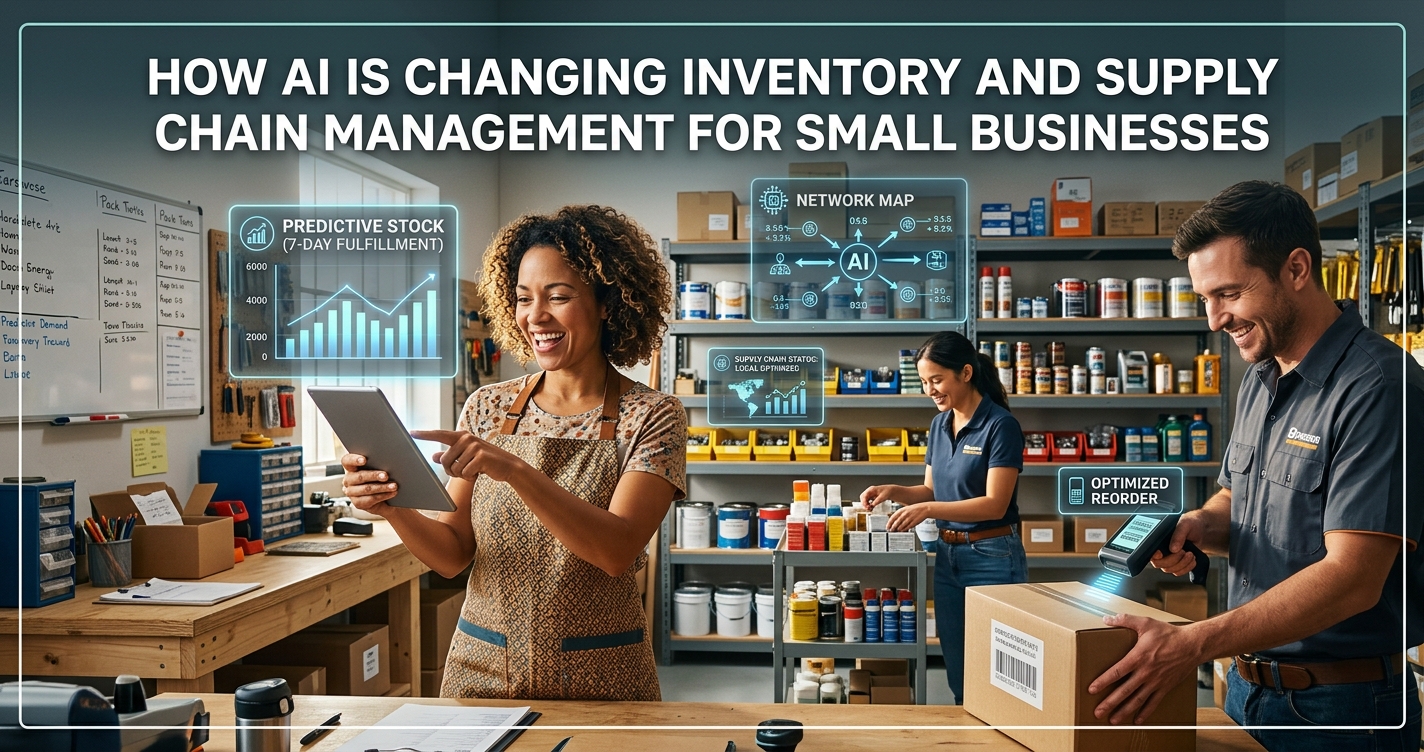
AI is changing small business inventory management by replacing manual, spreadsheet-based reordering with tools that predict demand, flag stockouts before they happen, and generate purchase orders automatically. For a 5–50 person business, this used to require enterprise software costing thousands per month, now tools like Zoho Inventory, Katana, Inventory Planner, and Prediko bring the same AI demand-forecasting capability to businesses running on a few hundred dollars a month.
Most content on “AI for supply chain” is written for enterprise logistics teams managing global distribution networks, not the reality of a small business owner manually checking stock levels in a spreadsheet, guessing at reorder quantities, and finding out about a stockout when a customer complains. That gap is exactly where the real opportunity sits right now: small businesses that adopt AI-driven inventory tools today are operating with a level of forecasting accuracy that used to be exclusive to companies with dedicated supply chain analysts.
Here’s what’s actually changed, and which tools make it accessible at small-business budgets.
What AI Actually Changes in Inventory Management
Before getting into specific tools, it’s worth being precise about what “AI-powered” means here, because the term gets used loosely.
- Demand forecasting — instead of reordering based on gut feel or last month’s sales, AI models analyze historical sales patterns, seasonality, and trends to predict what you’ll actually need, often at the individual SKU level.
- Automated reorder points — AI tools calculate when to reorder based on lead times, sales velocity, and safety stock needs, rather than a static “reorder at 10 units” rule that doesn’t adjust for seasonality or growth.
- Stockout and overstock alerts — instead of discovering a stockout when a customer tries to check out, these tools flag it days or weeks in advance based on current sell-through rate.
- Purchase order generation — several tools now generate suggested (or fully automated) purchase orders, cutting out the manual math of “how much do I order, and from whom.”
For a small business, the practical result is fewer emergency reorders, less cash tied up in overstocked slow-movers, and far less time spent manually checking stock levels across sales channels.
AI Inventory & Demand-Forecasting Tools Small Businesses Can Actually Afford
1. Zoho Inventory: Best Full Inventory Management Suite on a Budget
Zoho Inventory is built for growing businesses managing multichannel sales (Amazon, eBay, Shopify, and others) from one dashboard, with automated stock tracking and reorder workflows layered on top.
- Best for: Small businesses wanting a full inventory and order management system, not just a forecasting add-on
- Starting price: Free plan available; Standard plan from $79/month, Professional from $129/month
- Free trial: Yes, 14 days
- Why it fits 5–50 person businesses: It scales with you, you’re not paying for enterprise-level complexity on day one, and it integrates with Zoho’s broader suite (Books, CRM, Analytics) if you’re already in that ecosystem.
2. Katana Cloud Inventory: Best for Small Manufacturers and Product Businesses
Katana centers on giving small manufacturing and production businesses a live, centralized view of inventory, orders, and production, useful for businesses that make products, not just resell them.
- Best for: Small manufacturers and makers who need to track raw materials, work-in-progress, and finished goods together
- Starting price: Free plan available for very early-stage use; paid plans scale with order volume as the business grows (confirm current usage-based pricing directly, as it adjusts with order volume)
- Free trial: Yes
- Why it fits 5–50 person businesses: It’s specifically designed around small manufacturing workflows (bill of materials, production scheduling) that generic inventory tools don’t handle well.
3. Prediko: Best AI-First Demand Forecasting for Shopify Sellers
Prediko is built specifically around AI-driven demand forecasting and automated purchase orders for Shopify merchants, rather than being a general inventory system with forecasting bolted on.
- Best for: Shopify-based small businesses that want forecasting and reorder automation as the core feature, not an add-on
- Starting price: From $49/month
- Free trial: Yes, 14 days
- Why it fits 5–50 person businesses: It’s purpose-built for exactly this size of e-commerce operation — advanced enough to forecast accurately, simple enough to not require a dedicated analyst to run it.
4. Inventory Planner by Sage: Best for Multi-Channel Demand Planning
Inventory Planner focuses on advanced forecasting and SKU-level profitability analysis across multiple sales channels and warehouse locations, with automated replenishment suggestions.
- Best for: Small businesses selling across more than one channel (Shopify, Amazon, wholesale) who need forecasting that accounts for all of them together
- Starting price: Free to install, with usage-based pricing that adapts to business size (get a quote for your exact volume)
- Free trial: Yes
- Why it fits 5–50 person businesses: Multi-channel forecasting is exactly the kind of task that’s error-prone to do manually, this tool exists specifically to solve that without enterprise-level cost.
5. Forstock: Best Simple AI Reorder Tool for Small Shopify Brands
Forstock is a lighter-weight option aimed specifically at Shopify brands under roughly $250K in revenue, focused on straightforward AI reorder suggestions rather than deep analytics.
- Best for: Very small or early-stage e-commerce businesses that want AI help without a complex setup
- Starting price: Free to install; Starter plan from $39/month
- Free trial: Yes, 14 days
- Why it fits 5–50 person businesses: It’s explicitly scoped for smaller revenue brands, so you’re not paying for (or wading through) features built for much larger operations.
6. Assisty: Best for “Just Works” Simplicity
Assisty focuses on ease of use, AI forecasting, automated purchase order generation, and daily reports designed to require minimal setup and ongoing management.
- Best for: Small business owners who want AI inventory help without a learning curve
- Starting price: Free trial available (check current plan pricing directly, as tiers are usage-based)
- Free trial: Yes, 14 days
- Why it fits 5–50 person businesses: For a small team without a dedicated inventory manager, simplicity is often worth more than advanced configurability.
A Realistic Way to Start
You don’t need to evaluate all six of these at once. A practical approach:
- If you make physical products (not just resell them), start with Katana
- If you sell primarily through Shopify and want forecasting as the core feature, start with Prediko or Forstock
- If you sell across multiple channels and need a full inventory system (not just forecasting), start with Zoho Inventory
- If multi-location or multi-channel complexity is your biggest pain point, start with Inventory Planner
Most of these tools offer a free plan or trial specifically so you can test forecasting accuracy against your real sales history before committing, it’s worth running that test with at least one, since forecasting quality depends heavily on how much clean historical sales data you can feed it.
Frequently Asked Questions
Can a small business actually afford AI-powered inventory management? Yes. Tools like Zoho Inventory, Prediko, and Forstock start well under $100/month, and several offer free plans for very early-stage use, a significant shift from a few years ago when accurate demand forecasting was mostly limited to enterprise ERP systems.
How accurate is AI demand forecasting for a small business with limited sales history? Accuracy improves with more historical data, but most of these tools can still generate useful forecasts within a few months of consistent sales data, and accuracy typically improves as the tool accumulates more history on your specific products.
What’s the difference between a general inventory tool and a dedicated demand-forecasting tool? General inventory tools (like Zoho Inventory or Katana) manage stock levels, orders, and often production alongside forecasting. Dedicated forecasting tools (like Prediko or Forstock) focus specifically on predicting demand and generating reorder suggestions, usually as an add-on to a sales platform you already use.
Do I need a data or supply chain background to use these tools? No. All of the tools listed here are built for small business owners without a dedicated analyst, the AI handles the forecasting math, and the interface is designed around simple recommendations (“reorder 50 units of X by this date”) rather than raw data you have to interpret yourself.
What’s the biggest mistake small businesses make when adopting AI inventory tools? Expecting instant, perfect accuracy. Forecasting tools need clean historical sales data to work well, a business with messy, inconsistent inventory records will get weaker forecasts at first. It’s worth spending a little time getting your existing data organized before expecting the AI to fully take over reorder decisions.
Leave a Reply